
 FAST SAME DAY & AFTER HOURS DELIVERY


Visit Our Showroom For Mobility Scooters, Lift Chairs & More
We Deliver to Your Area



I had a great experience with eCare Medical Supplies. James was my delivery specialist and went above and beyond to ensure everything went smoothly. He took extra time to make sure the rental equipment was installed properly and that I was fully trained and comfortable using it. He was extremely professional, patient, and knowledgeable.
When James returned to pick up the equipment, he was just as kind and courteous. He checked in to see how the equipment worked for me and made the entire process seamless from start to finish. Excellent customer service—thank you, James and the eCare team


The services and products from this company are outstanding - definitely five ⭐️. The delivery was on time and professional.
James was our representative and carefully explained the features of the wheelchair and its proper use. James is outstanding ⭐️⭐️⭐️⭐️⭐️ - we very much appreciate his concern and support.
We recommend E Care Medical Supply to anyone in need of excellent equipment and service at fair prices -
David & Donna


James and Aron were the best of the best!
Friendly, thorough, and very knowledgeable, I could not have asked for a better experience.
Of course, I hope to not need medical equipment rental again, but if I do, E Care will be my go to, and hope that delivery will be by James and Aron!
If only all businesses could be run in such an efficient and friendly manner.

The in store personnel were prepared to answer all our questions, and helped with our selection.
The delivery was actually earlier than expected with the delivery team of James and Aron. They were extremely professional and made sure everything was installed and working properly and then went over its operation.

T-Roy Broussard,
Port Arthur, Texas

I highly recommend them!


It’s rare to find someone who genuinely cares, but James went above and beyond. Thank you, E Care Medical Supplies, for making an important process feel easy and supported!


James, the person who delivered the chair, was very personable, professional and courteous. He was thorough in setting up the chair, making sure there was enough length on the power cord and made sure my husband and I understood how to use the chair so we could instruct my mother. He was a breath of fresh air.
Overall, I was very impressed with the service E Care provided from ordering to delivery.


Yvette was my primary contact. Both she and Kelsey answered any questions and concerns I had.
When I returned to pick up a chair I purchased, both James and Aron were very patient with me in explaining how to set up my chair at home.
Then they carefully wrapped my chair and helped me load it into my van.
I can't say enough good things about Yvette, Kelsey, James and Aron.
They are excellent representatives of E Care Medical Supplies.
I am a satisfied customer!










E Care's Blog Post - Post-Surgery Mobility Aids: Walker, Wheelchair, or Both?

Coming home from surgery can feel overwhelming, especially when your mobility is temporarily limited. One of the most common questions patients ask is:...
Post-Surgery Mobility Aids: Walker, Wheelchair, or Both?
May 1, 2026 - Mobility & Independence
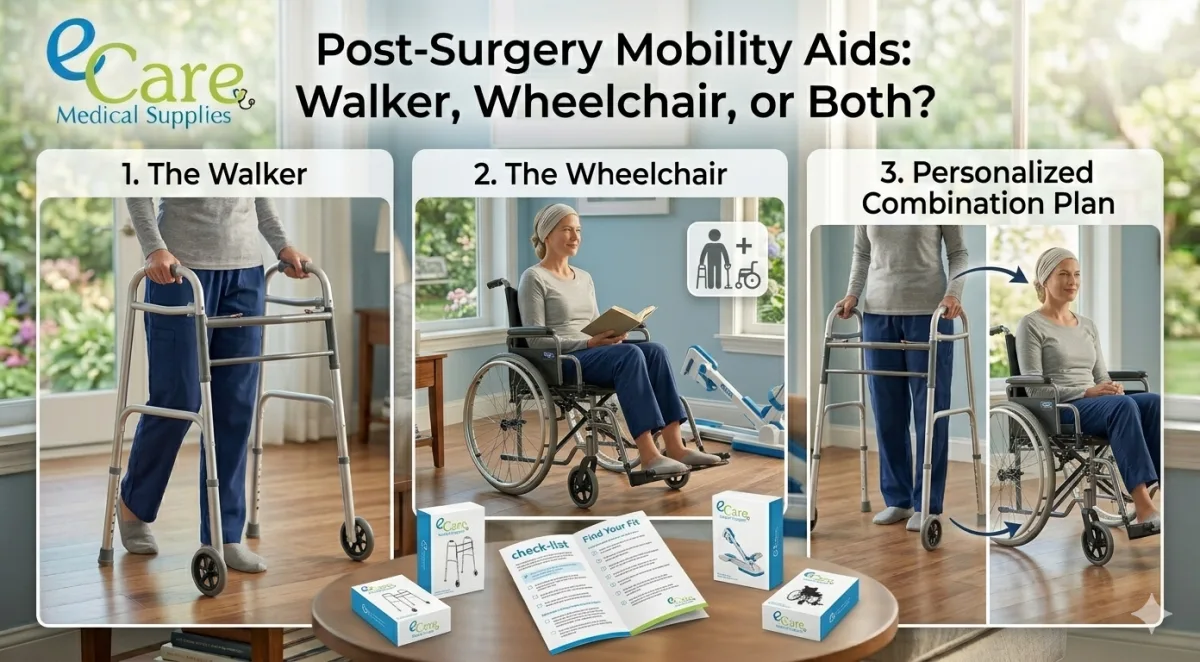
Coming home from surgery can feel overwhelming, especially when your mobility is temporarily limited. One of the most common questions patients ask is: "Do I need a walker, wheelchair, or both for my recovery?" The answer depends on your specific surgery, recovery timeline, and individual needs. Let's explore how to make the right choice for your healing journey.
Understanding Your Post-Surgery Mobility Needs
Your mobility requirements after surgery depend on several factors that your healthcare team will discuss with you. The type of procedure you've had—whether it's orthopedic surgery, abdominal surgery, or cardiac procedures—directly impacts how much weight you can bear and how far you can safely move.
For surgeries involving the legs, hips, or spine, you may have strict weight-bearing restrictions. Heart or lung surgeries might limit your endurance, while abdominal procedures could affect your core stability. Remember, this information is educational—your doctor or physical therapist should always provide specific guidance for your situation.
When a Walker Might Be Your Best Choice
Walkers provide excellent stability and support when you can bear some weight on your legs but need extra balance assistance. They're ideal for short to medium distances around your home and can help you maintain independence for daily activities like getting to the bathroom or kitchen.
Standard walkers require you to lift the frame with each step, while wheeled walkers (rollators) allow for smoother movement. If you're recovering from knee replacement, hip surgery, or have balance concerns, a walker often becomes your trusted companion during the healing process.
Why You Might Need a Wheelchair
Wheelchairs become essential when weight-bearing restrictions are strict, when you need to conserve energy, or when longer distances are involved. They're particularly valuable during the early recovery phase when fatigue levels are high and healing tissues need protection.
For patients recovering at home in Houston, a wheelchair can be invaluable for medical appointments, family gatherings, or simply moving around your house when standing becomes too tiring. Many patients find that having both options gives them flexibility as their recovery progresses.
The Case for Having Both Options
Recovery isn't linear, and your needs may change from day to day or even throughout a single day. You might use a wheelchair for longer outings or on days when you're more fatigued, while relying on a walker for short trips around your home when you're feeling stronger.
Having both options available allows you to listen to your body and choose the appropriate aid for each situation. This flexibility can actually speed your recovery by preventing overexertion while still encouraging appropriate movement.
Practical Recovery Tips
- Start conservatively: It's better to use more support initially and gradually reduce assistance as you heal
- Prepare your home: Clear pathways, secure rugs, and ensure good lighting for safe mobility
- Practice before you need it: If possible, familiarize yourself with your mobility aids before surgery
- Consider your daily routine: Think about distances you'll need to travel and activities you want to maintain
- Plan for progression: Your needs will likely change as you heal, so flexibility is key
- Don't rush the process: Using mobility aids appropriately can prevent setbacks and complications
Key Takeaways
- The choice between walker, wheelchair, or both depends on your specific surgery, restrictions, and recovery goals
- Walkers provide stability for weight-bearing mobility, while wheelchairs offer complete support and energy conservation
- Having both options available provides flexibility as your recovery needs change day by day
- Your healthcare team should guide your specific mobility aid selection based on your medical situation
- Proper mobility aid use can actually accelerate recovery by preventing overexertion and protecting healing tissues
Frequently Asked Questions
How long will I need mobility aids after surgery?
Recovery timelines vary greatly depending on your surgery type, age, and overall health. Some patients use aids for just a few weeks, while others may need them for several months. Your surgeon and physical therapist will provide specific guidance based on your healing progress.
Is it better to buy or rent mobility equipment?
For short-term recovery needs, renting is often more cost-effective and practical. Rental options allow you to try different types of equipment and upgrade or downgrade as your needs change during recovery.
Can I use a regular wheelchair instead of a walker?
While wheelchairs provide excellent support, using a walker when appropriate helps maintain muscle strength and promotes healing. Your healthcare team will advise when it's beneficial to bear weight and when to avoid it.
What if my mobility needs change during recovery?
This is completely normal! Many patients find their needs fluctuate as they heal. Having flexible rental options allows you to adjust your equipment as your recovery progresses.
Do I need a prescription for mobility aids?
Most mobility aids don't require a prescription, though insurance coverage may vary. Your healthcare provider can write orders if needed for insurance purposes.
How E Care Medical Supplies Can Help
Whether you need a walker, wheelchair, or both for your recovery, our flexible rental program lets you adapt your mobility aids as your needs change. We offer same-day delivery across Houston, so you can focus on healing while we handle the logistics.
View Rental OptionsRated 4.8 stars on Google · Houston, TX · No prescription required · Same-day & after-hours delivery · Hablamos español · (713) 695-4939
This article is for informational and educational purposes only and does not constitute medical advice. Always consult a qualified healthcare provider for personal medical decisions.
Tags: post-surgery,mobility aids,walker,wheelchair,recovery,rehabilitation,mobility equipment
← Back to Blogs