 FAST SAME DAY & AFTER HOURS DELIVERY


Visit Our Showroom For Mobility Scooters, Lift Chairs & More
We Deliver to Your Area



I had a great experience with eCare Medical Supplies. James was my delivery specialist and went above and beyond to ensure everything went smoothly. He took extra time to make sure the rental equipment was installed properly and that I was fully trained and comfortable using it. He was extremely professional, patient, and knowledgeable.
When James returned to pick up the equipment, he was just as kind and courteous. He checked in to see how the equipment worked for me and made the entire process seamless from start to finish. Excellent customer service—thank you, James and the eCare team


The services and products from this company are outstanding - definitely five ⭐️. The delivery was on time and professional.
James was our representative and carefully explained the features of the wheelchair and its proper use. James is outstanding ⭐️⭐️⭐️⭐️⭐️ - we very much appreciate his concern and support.
We recommend E Care Medical Supply to anyone in need of excellent equipment and service at fair prices -
David & Donna


James and Aron were the best of the best!
Friendly, thorough, and very knowledgeable, I could not have asked for a better experience.
Of course, I hope to not need medical equipment rental again, but if I do, E Care will be my go to, and hope that delivery will be by James and Aron!
If only all businesses could be run in such an efficient and friendly manner.

The in store personnel were prepared to answer all our questions, and helped with our selection.
The delivery was actually earlier than expected with the delivery team of James and Aron. They were extremely professional and made sure everything was installed and working properly and then went over its operation.

T-Roy Broussard,
Port Arthur, Texas

I highly recommend them!


It’s rare to find someone who genuinely cares, but James went above and beyond. Thank you, E Care Medical Supplies, for making an important process feel easy and supported!


James, the person who delivered the chair, was very personable, professional and courteous. He was thorough in setting up the chair, making sure there was enough length on the power cord and made sure my husband and I understood how to use the chair so we could instruct my mother. He was a breath of fresh air.
Overall, I was very impressed with the service E Care provided from ordering to delivery.


Yvette was my primary contact. Both she and Kelsey answered any questions and concerns I had.
When I returned to pick up a chair I purchased, both James and Aron were very patient with me in explaining how to set up my chair at home.
Then they carefully wrapped my chair and helped me load it into my van.
I can't say enough good things about Yvette, Kelsey, James and Aron.
They are excellent representatives of E Care Medical Supplies.
I am a satisfied customer!










E Care's Blog Post - Safe Patient Lifting at Home: Essential Stand-Up Lift Information for Seniors and Caregivers

Safe Patient Lifting at Home: Essential Stand-Up Lift Information for Seniors and Caregivers As we age or face mobility challenges, simple...
Safe Patient Lifting at Home: Essential Stand-Up Lift Information for Seniors and Caregivers
April 8, 2026 - mobility aids
Safe Patient Lifting at Home: Essential Stand-Up Lift Information for Seniors and Caregivers
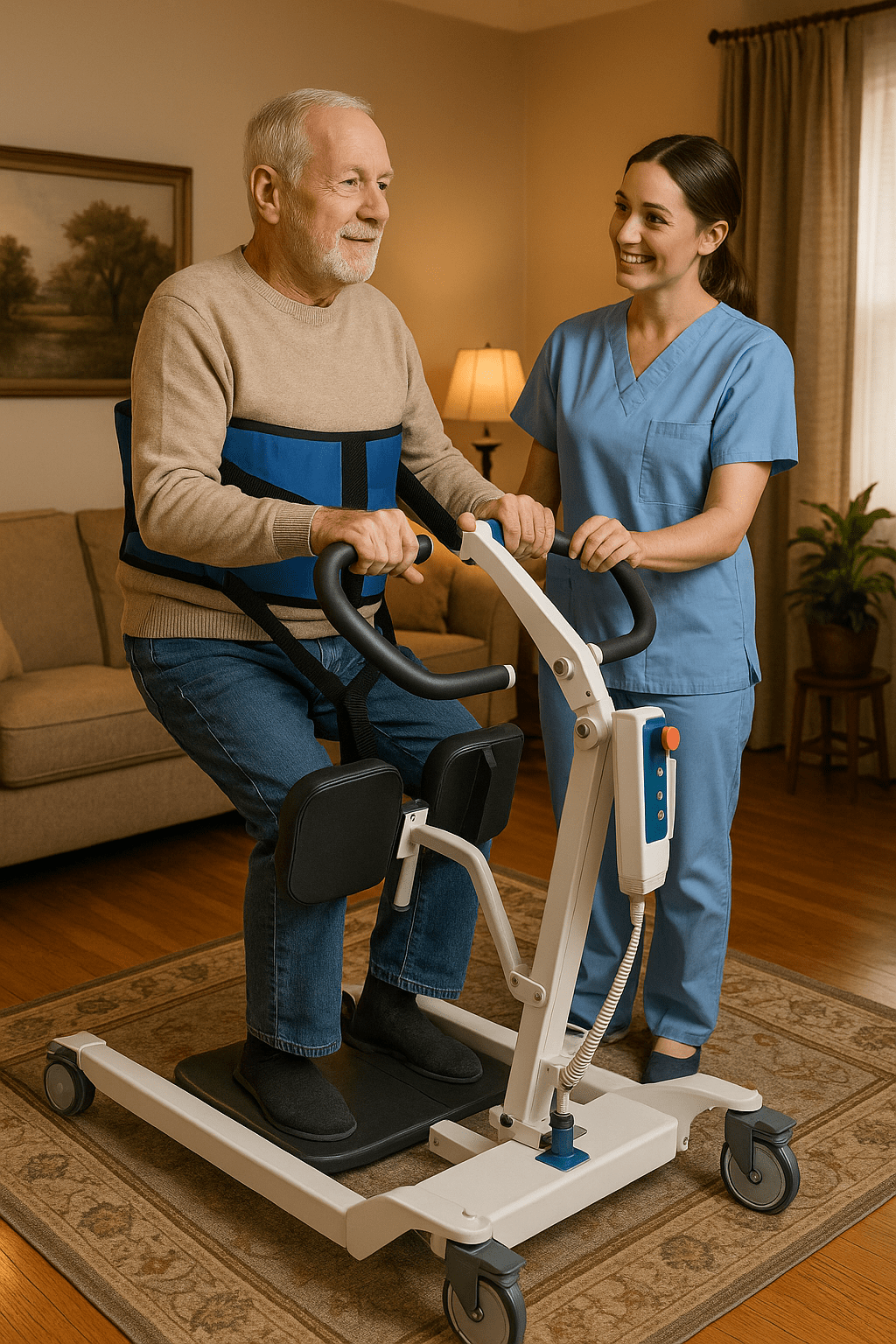
As we age or face mobility challenges, simple tasks like standing up can become incredibly difficult. A stand-up lift, or standing transfer aid, offers a lifeline, providing comfort, safety, and dignity for individuals with limited mobility.
What is a Stand-Up Lift?
A stand-up lift is a mechanical device designed to assist individuals with limited mobility in standing up from a seated position. It is an invaluable tool for those who struggle with the physical demands of sitting to standing transitions, providing both safety and independence. These lifts are particularly useful in home healthcare, nursing homes, and assisted living settings, where individuals require additional assistance to stand or transfer.
Stand-up lifts are essential for promoting comfort, reducing the risk of falls, and helping both patients and caregivers with ease of mobility. These devices are designed to lift individuals from a seated to a standing position in a safe, controlled manner, allowing for seamless transfers between beds, chairs, or wheelchairs.
Who Can Benefit from a Stand-Up Lift?
Stand-up lifts are ideal for individuals who:
- Seniors and Individuals with Limited Mobility: Stand-up lifts offer a safe way to transition from sitting to standing, especially for seniors with arthritis, muscle weakness, or other age-related mobility issues.
- Assisted Living or Nursing Home Staff: Caregivers working in healthcare settings can benefit from stand-up lifts, reducing strain and injury when helping patients with transfers.
- People with Chronic Respiratory Issues: For individuals with conditions like COPD, the ability to stand can improve lung capacity and reduce the risk of respiratory complications.
- Home Healthcare Professionals: Occupational and physical therapists can use stand-up lifts to help patients regain mobility and independence safely.
- Uninsured Individuals: For people who need a lift but don't have insurance coverage, renting a stand-up lift offers an affordable solution with the option to pay out of pocket.
Benefits of Stand-Up Lifts
Stand-up lifts provide numerous benefits, making them an essential piece of equipment for improving the quality of life for individuals with mobility challenges:
- Improved Safety: The primary benefit of a stand-up lift is safety. By reducing the physical effort required to stand up, these devices minimize the risk of falls and injuries caused by instability or sudden movements.
- Enhanced Comfort: Many users report less pain and discomfort when using a stand-up lift, as they help to reduce muscle strain and joint stress, making standing up a smoother process.
- Independence: Stand-up lifts promote independence, giving users the ability to perform transfers without constant assistance from caregivers.
- Reduced Caregiver Strain: For caregivers, stand-up lifts reduce the physical toll that transfers and lifting can take, making the job less strenuous and safer.
- Versatility: Stand-up lifts come in both manual and power-operated models, offering flexibility to suit different needs and environments.
How Does a Stand-Up Lift Work?
Stand-up lifts typically feature a padded seat or platform where the user can sit. The device uses either a manual or electric motor to lift the individual from a seated position into a standing position. Depending on the model, the user may either remain standing on the platform or be fully supported during the transfer.
Most stand-up lifts have adjustable components to accommodate different heights and sizes, making them suitable for a wide range of users. The lift’s design ensures that the individual is safely positioned and supported throughout the process, preventing falls and ensuring comfort.
Key Features to Look For:
- Weight Capacity: Ensure that the lift supports the user's weight. Many models can accommodate users up to 350 lbs or more.
- Ease of Use: Power-operated lifts are user-friendly, offering push-button controls for smooth transitions. Manual lifts, while more affordable, require more effort from the caregiver.
- Portability: Some models are lightweight and easy to transport, making them ideal for home use or temporary rentals.
- Adjustability: Adjustable height and width features allow for a customized fit, ensuring the lift is comfortable and effective for a wide range of body types.
Do You Need Upper or Lower Extremity Strength to Use a Stand-Up Lift?
One of the great advantages of a stand-up lift is that it significantly reduces the need for upper or lower extremity strength, making it accessible for individuals with varying levels of mobility. While some degree of strength and coordination may be beneficial, stand-up lifts are designed to assist individuals who may have limited strength or mobility in their legs, arms, or both.
For Lower Extremity Strength:
Although a person does not need full strength in their legs to use a stand-up lift, it is helpful if the individual has some ability to assist with the transfer. For example, individuals who have enough strength to support a small amount of weight or to maintain a semi-standing position can more easily use a stand-up lift to transition between sitting and standing. However, even those with limited leg strength can use the lift effectively with the support of the device.
For Upper Extremity Strength:
Upper body strength is not a critical requirement for using a stand-up lift. Most models allow the user to remain in a semi-seated position, where they can rely on the lift to assist with the majority of the movement. In fact, many stand-up lifts are designed with easy-to-use controls that allow for a smooth, controlled lift without requiring significant upper body strength. This makes stand-up lifts ideal for people with weak or limited use of their arms and hands.
In Summary:
While some minimal strength in the lower body can help facilitate the transfer, stand-up lifts are designed to provide support for individuals with limited strength in both their upper and lower extremities. The lift’s mechanical features do most of the heavy lifting, ensuring that users of all strength levels can benefit from the device, enhancing safety and comfort during transfers.
Stand-Up Lift Rental Options
If you're unsure whether a stand-up lift is the right choice, renting one is a great option. At E Care Medical Supplies, we offer a range of stand-up lifts for rent, including both manual and power-operated models. Renting allows you to try out the equipment before making a commitment to purchase, and it's an affordable solution for short-term needs.
Available Stand-Up Lift Rentals in Houston:
- Stand-Up Patient Lifts Rentals in Houston
- Reliant 350 Power Stand-Up Lift (350 lbs Capacity) Rental
- Manual Stand Aid Standing Transporter (400 lbs Capacity) Rental
- Standing Patient Transfer Aid Rental in Houston
Need it today? We offer same-day delivery for most rentals! Call us now or visit our showroom to reserve your stand-up lift.
FAQs
What is the weight capacity of the stand-up lift?
Most stand-up lifts can support up to 350 lbs, though heavier models are available for individuals with greater needs. Always check the specifications before use.
How long can I rent a stand-up lift?
Rental periods vary, and we offer flexible options to meet both short-term and long-term needs. You can rent a stand-up lift by the week or month.
Can a stand-up lift be used by people with specific health conditions?
Yes! Stand-up lifts are suitable for individuals with conditions like arthritis, spinal injuries, stroke recovery, and chronic respiratory issues. Consult with your healthcare provider for specific recommendations.
How do I reserve a stand-up lift?
Reserving a stand-up lift is easy! Simply visit our reservation page and choose the model that suits your needs.
Tags: stand-up lift, stander for adults, sit to stand transfer aid, patient stand up, patient lift assist, stand, getup, getting up, lift, transfer, floor to, standing, disable, disability, stander
← Back to Blogs